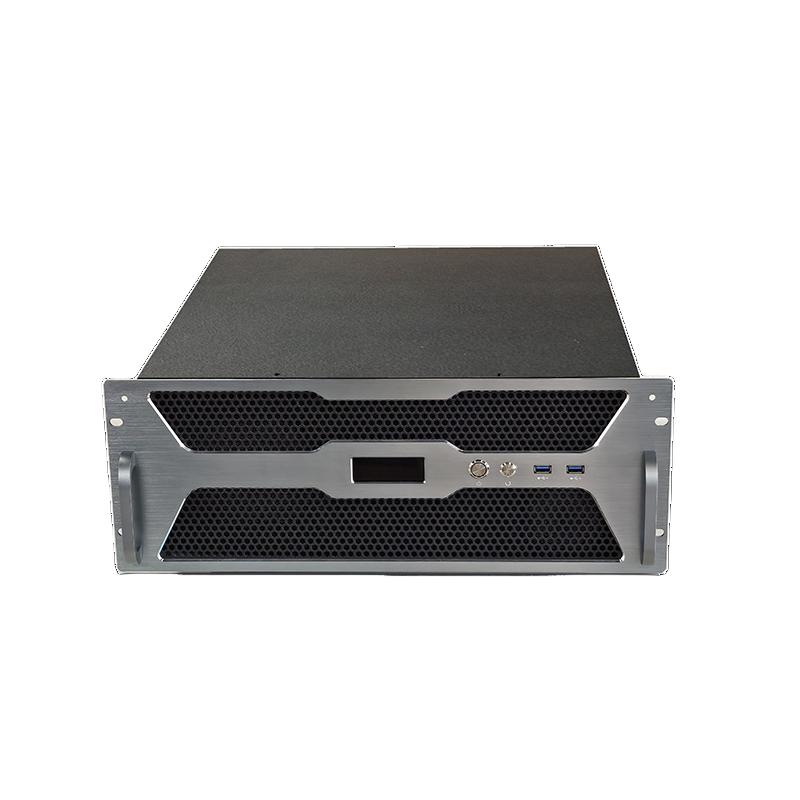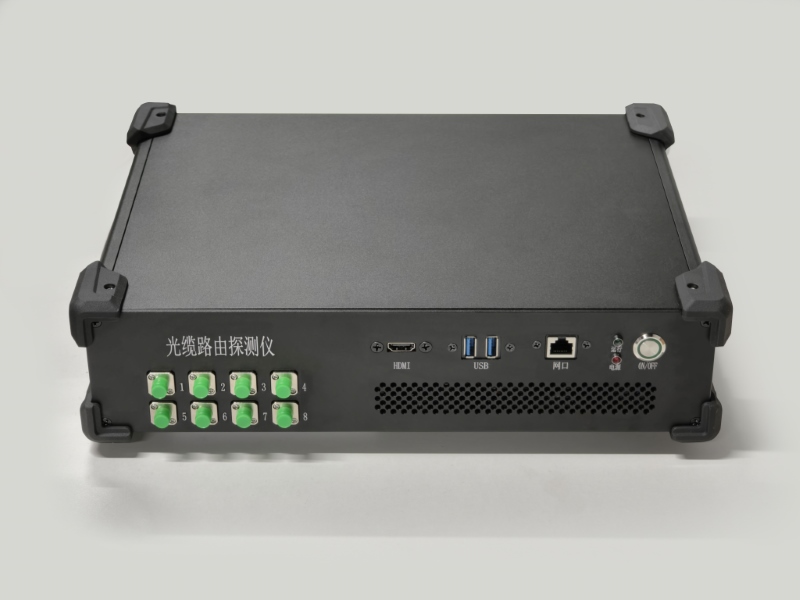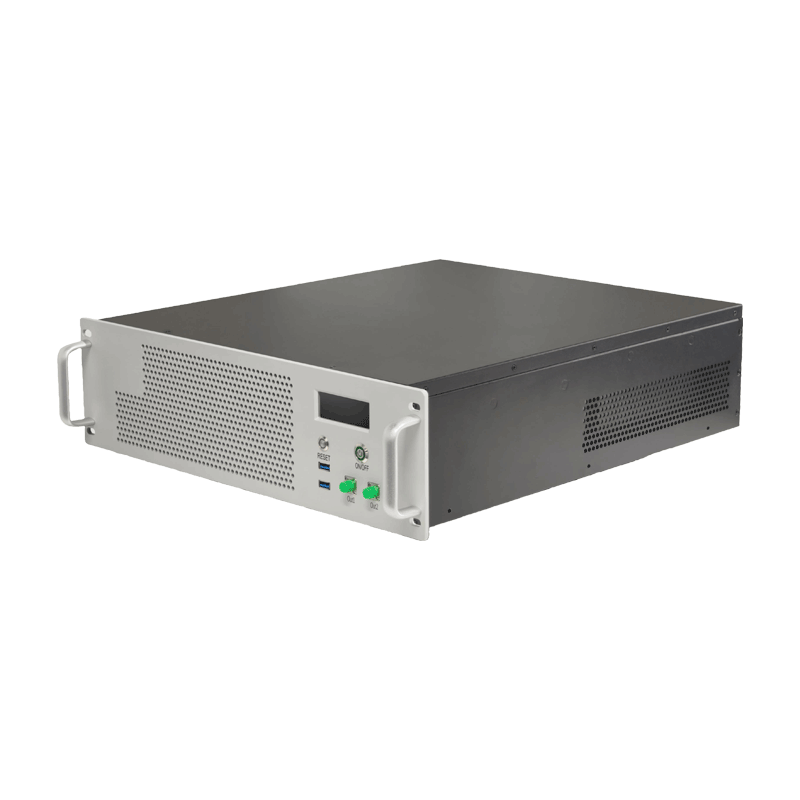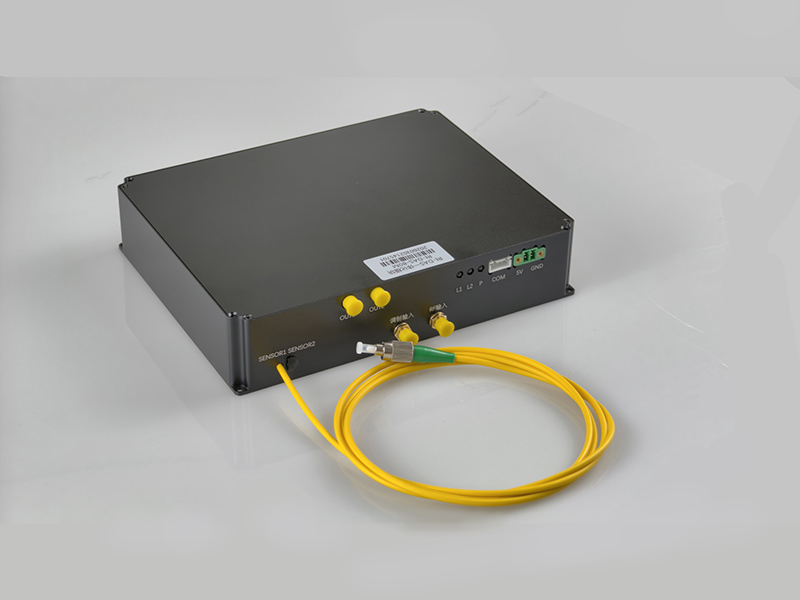
DAS Integration Module Supporting Customized Pulsed RF Input
A DAS integration module supporting customised pulsed RF inputs, capable of accepting 80/200 MHz pulse signals and also receiving chirp-modulated pulse signals.
 Huang
Email: Hqy@ybphotonics.com
Huang
Email: Hqy@ybphotonics.com
Summarize
This DAS module integrates the optical path for Distributed Acoustic Sensing (DAS). It features a built-in AOM that supports both RF and digital TTL-modulated inputs; therefore, the user must input an 80 MHz or 200 MHz RF signal, which is then modulated into pulses via a TTL-modulated signal.
This DAS integrated module is a highly integrated core optoelectronic kit designed specifically for high-performance distributed acoustic fiber sensing systems.
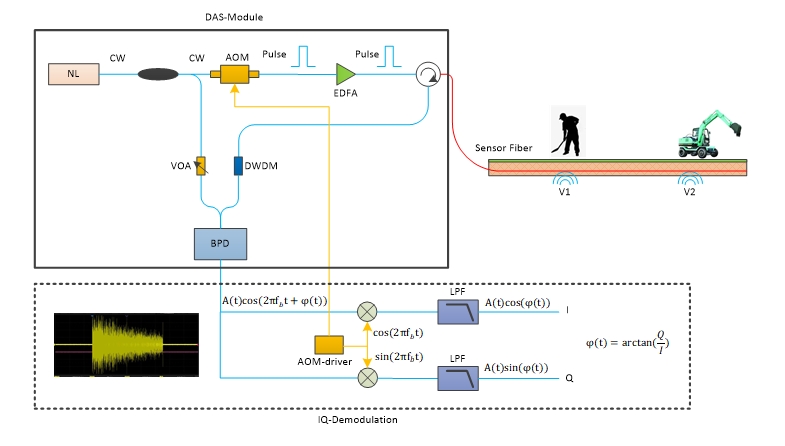
The module integrates a narrow-linewidth laser, an AOM, an EDFA optical amplifier, a balanced photodetector, and a precision hardware clock synchronization circuit within an ultra-compact housing.
When used in conjunction with our proprietary DAQ+AWG architecture high-speed data acquisition card, this DAS module offers superior clock synchronization compared to traditional solutions that rely on a common clock source for the AOM and DAQ. The DAS’s AOM is driven by RF pulses generated by the AWG, ensuring not only full clock synchronization with the DAQ but also complete consistency in the initial phase of the pulses. This enables high-speed acquisition and real-time demodulation of all-fiber signals, thereby significantly enhancing the system’s demodulation stability and reliability in long-distance and weak-signal scenarios. Users can rapidly build fully real-time, long-distance, high-resolution, industrial-grade DAS measurement systems.
Features
- High integration
- Modular design
- High-precision clock synchronization
- High stability and reliability
- Customizable form factor
Applications
- Optical Research
- Perimeter Intrusion Monitoring
- Oil and Gas Pipeline Leak Early Warning
- Railway Corridor Safety Monitoring
- Structural Health Monitoring of Tunnels and Slopes
- Condition Monitoring of Submarine and Land Cables
- Vibration Monitoring of Urban Infrastructure
Internal Optical Path Diagram of the Module
Core Parameters
| Parameter | Min | Typical | Max | Unit | Remark |
|---|---|---|---|---|---|
| Measurement Distance | 40 | 60 | - | km | 60km@Raman Enabled |
| TTL Enable Pulse Width | 40 | 120 | 520 | ns | >20ns |
| RF Pulse Width | 20 | 100 | 500 | ns | - |
| Pulse Frequency | - | 50 | - | kHz | - |
| Spatial Resolution | 5 | 10 | - | m | 5m@50ns |
| Response Frequency | 1 | 25k | - | Hz | 50kHz@1km |
| Low Frequency Response Range | 1 | 1k | - | Hz | Tested with our DAQ card |
| High Frequency Response Range | 1k | - | 25k | Hz | - |
| Response Stability | - | Fluctuation <1% in full band | - | - | - |
| Operating Temperature | -20 | - | 60 | ℃ | - |
| Storage Temperature | -30 | - | 70 | ℃ | - |
| Communication Interface | - | TTL Serial Port | - | - | - |
| Communication Protocol | - | Modbus-RTU | - | - | - |
Ultra-Narrow Linewidth Laser Source Parameters
| Parameter | Min | Typical | Max | Unit | Remark |
|---|---|---|---|---|---|
| Operating Wavelength | - | 1550.12 | - | nm | - |
| Output Power | - | 10 | 13 | dBm | - |
| Linewidth | - | <3 | - | kHz | Customizable |
| Relative Intensity Noise | - | <120 | - | dB/Hz | - |
| Wavelength Drift | - | ±1 | - | pm | - |
| Power Stability | - | - | ±2% | - | Full temperature range |
| Side Mode Suppression Ratio | 60 | - | - | dB | - |
Pulse EDFA Parameters
| Parameter | Min | Typical | Max | Unit | Remark |
|---|---|---|---|---|---|
| Operating Wavelength Range | - | 1550.12 | - | nm | - |
| Input Peak Optical Power | - | 10 | - | dBm | - |
| Input Average Optical Power | -35 | -30 | - | dBm | - |
| Output Peak Optical Power | - | 23 | - | dBm | - |
| Output Average Optical Power | - | - | 0 | dBm | - |
| Repetition Frequency | - | - | 100 | kHz | - |
| Noise Figure | - | 5.5 | - | dB | - |
| Polarization Dependent Gain | - | - | 0.5 | dB | - |
| Polarization Mode Dispersion | - | - | 0.5 | ps | - |
Acousto-Optic Modulator Parameters
| Parameter | Min | Typical | Max | Unit | Remark |
|---|---|---|---|---|---|
| Operating Wavelength | 1530 | - | 1570 | nm | - |
| Operating Frequency | - | 200 (Center Frequency) | - | MHz | Customizable |
| Insertion Loss | - | ≤3.5 | - | dB | - |
| Rise Time | - | <15 | - | ns | - |
| Extinction Ratio | - | ≥50 | - | dB | - |
| Polarization Dependent Loss | - | ≤0.5 | - | dB | - |
| Withstand Optical Power | - | ≤0.5 | - | W | - |
Raman Amplifier (Optional) Parameters
| Parameter | Min | Typical | Max | Unit | Remark |
|---|---|---|---|---|---|
| Laser Wavelength | - | 1455 | - | nm | - |
| Output Power Range | - | 25 | 26 | dBm | - |
Differences between this module and other standard DAS modules
This module supports full-range RF signal input. For example, if you select a DAS module designed for a 200 MHz intermediate frequency signal, you can use an AWG to directly output a 200 MHz signal. Alternatively, you can provide your own chirped pulse signals to achieve higher-performance DAS.
Interface Definition
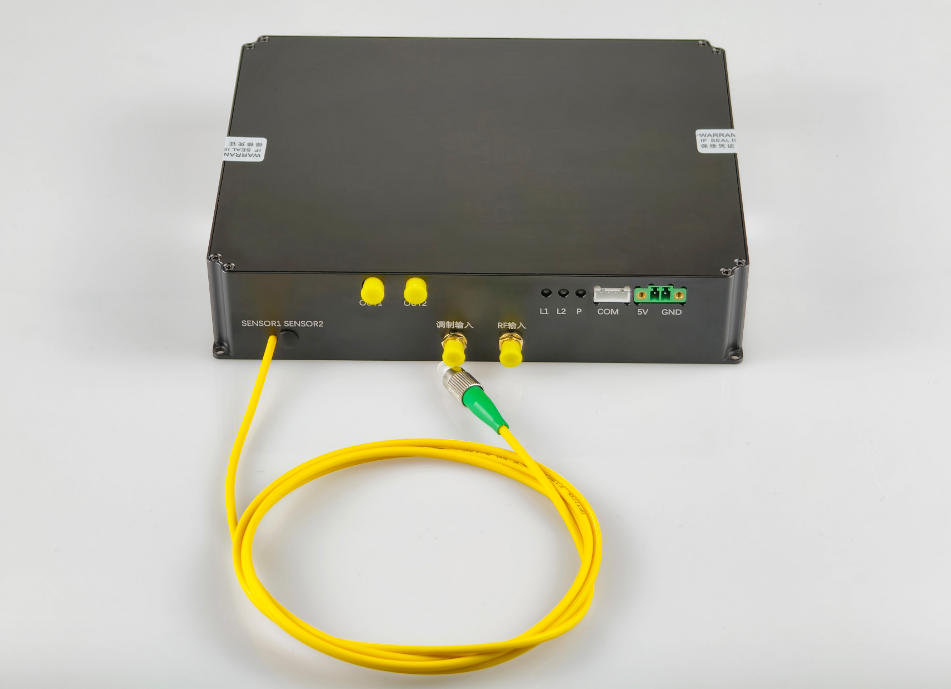
| Interface Type | Silkscreen | Description |
|---|---|---|
| Green Plug-in Terminal | 12V | DC power supply +12V power input |
| Green Plug-in Terminal | GND | DC power supply GND |
| White Plug-in Terminal | COM | Serial port, TTL level, used for parameter adjustment by communicating with a computer |
| SMA | Modulation Input | AOM modulation signal input |
| SMA | RF Input | Dedicated for chirp models |
| Optical Fiber Interface | Sensor1 | Connect to sensing fiber 1, default FC/APC connector, used for single-channel products |
| Optical Fiber Interface | Sensor2 | Connect to sensing fiber 2, default FC/APC connector |
| SMA | OUT1 | Module channel 1 output voltage signal, used for single-channel products |
| SMA | OUT2 | Module channel 2 output voltage signal |
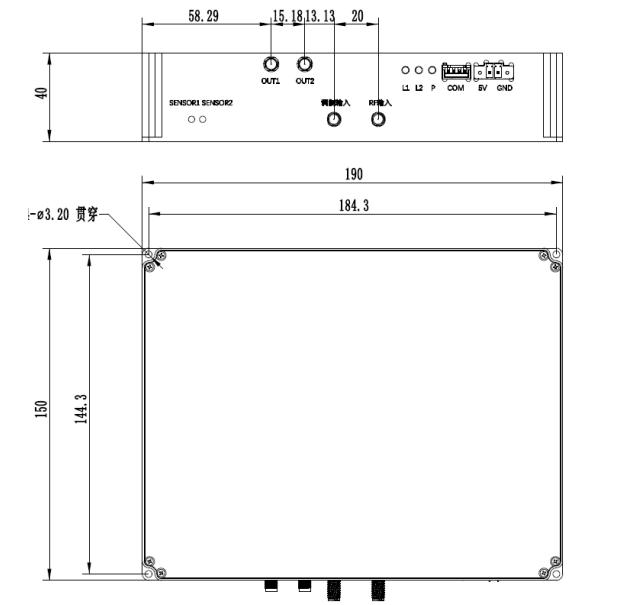
Mechanical Dimension Drawing
What kind of capture card is needed?
Since this DAS module requires the output of 80/200 MHz RF signals, the data acquisition card must include an AWG function. To meet this requirement, we have specifically developed a 1 Gbps high-speed data acquisition card that also integrates an AWG function.
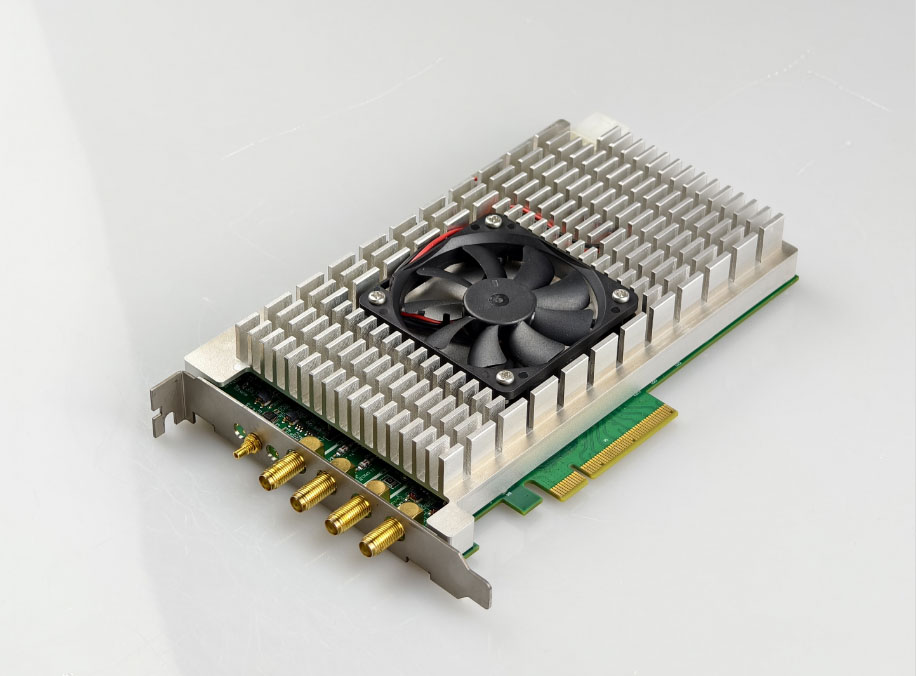
GY-DAQA-2510, View Detail
The pulse modulation of the DAS module is generated by the RF pulse modulator on the acquisition card, and the TTL trigger output signal from the acquisition card is used to enable modulation of the module.
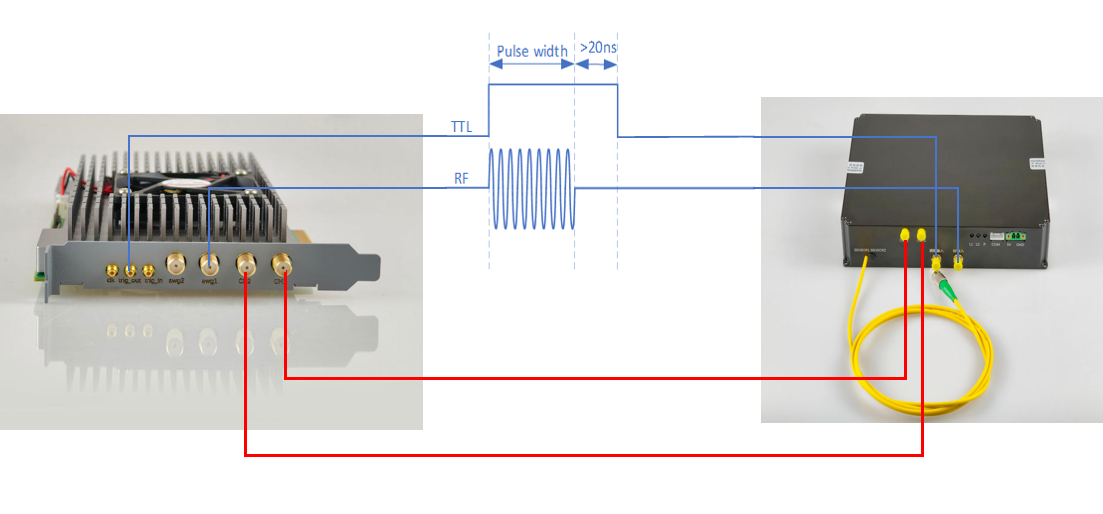
Schematic Diagram of the Connection Between the GY-DAQA-2510 and the DAS Module
- Connect the AWG1 pin on the data acquisition card to the RF input of the DAS module.
- Connect the trigger output of the data acquisition card to the modulation input of the DAS module.
- Connect CH1 on the data acquisition card to CH1 on the DAS module.
- Connect CH2 on the data acquisition card to CH2 on the DAS module (if the DAS module has only one sensor fiber, this connection is optional).
Two Combinations with the Capture Card
Option 1: Use this DAS module and the GY-DAQA-2510 to build a DAS system for chirp pulses.
For this solution, you must configure the AWG output signal of the GY-DAQA-2510 yourself. You can set the chirp pulse waveform, and then the data acquisition card will capture the raw data, which you will need to demodulate yourself.
Option 2: Use this DAS module and the GY-DAQ-2510DA to build a DAS system with full-clock synchronization.
With this solution, the GY-DAQ-2510DA can output the required 80M/200M RF signals as well as triggered TTL signals, and demodulation is already implemented within the acquisition card’s FPGA. This makes it more convenient to use.
Ordering Information
| Model | Type | Channels | Distance | Intermediate Frequency | Laser linewidth | Features |
|---|---|---|---|---|---|---|
| GY-DAS-RF-1-1-40-80 | RF Signal Input | 1 | ≤40km | 80M | <1kHz | Good signal quality |
| GY-DAS-RF-2-1-40-80 | RF Signal Input | 2 | ≤40km | 80M | <1kHz | Good signal quality |
| GY-DAS-RF-1-3-40-80 | RF Signal Input | 1 | ≤40km | 80M | <3kHz | Good signal quality |
| GY-DAS-RF-2-3-40-80 | RF Signal Input | 2 | ≤40km | 80M | <3kHz | Good signal quality |
| GY-DAS-RF-1-1-40-200 | RF Signal Input | 1 | ≤40km | 200M | <1kHz | Good signal quality |
| GY-DAS-RF-2-1-40-200 | RF Signal Input | 2 | ≤40km | 200M | <1kHz | Good signal quality |
| GY-DAS-RF-1-3-40-200 | RF Signal Input | 1 | ≤40km | 200M | <3kHz | Good signal quality |
| GY-DAS-RF-2-3-40-200 | RF Signal Input | 2 | ≤40km | 200M | <3kHz | Good signal quality |
Testing the background noise at different pulse frequencies
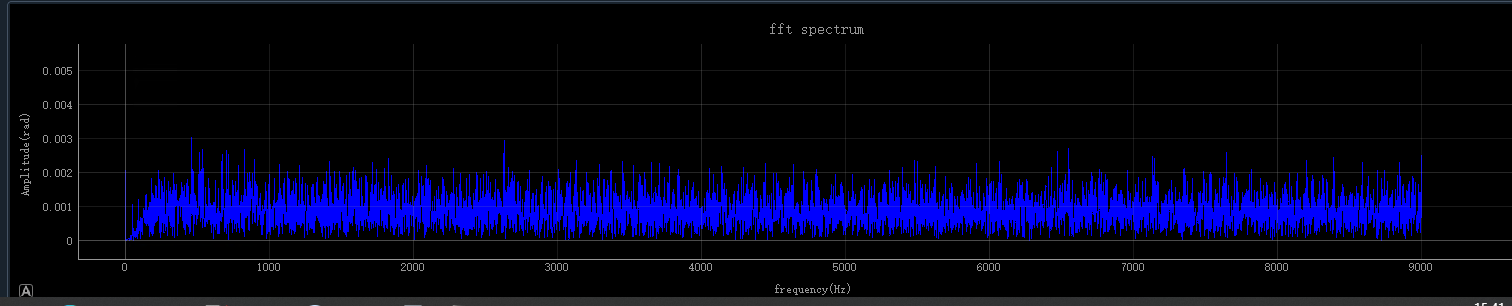
When the pulse frequency is set to 18kHz, the background noise signal is clean, with no abnormal frequencies.

When the pulse frequency is set to 14kHz, the background noise signal is clean, with no abnormal frequencies.

When the pulse frequency is set to 12kHz, the background noise signal is clean, with no abnormal frequencies.
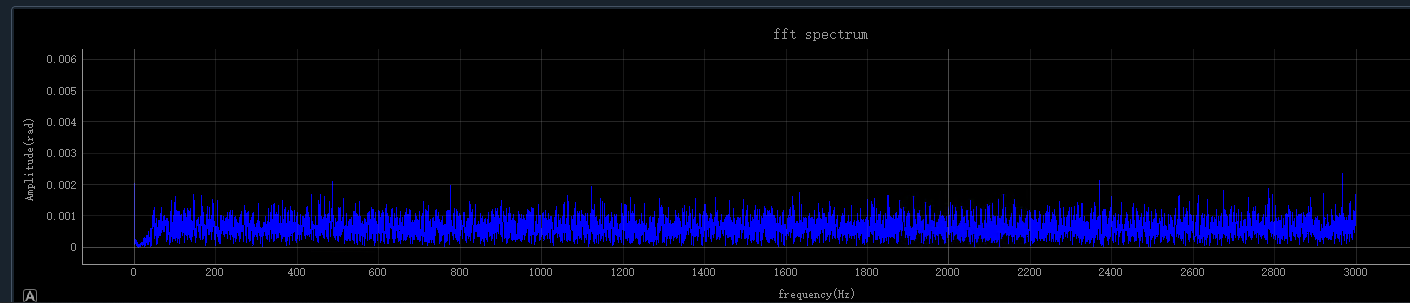
When the pulse frequency is set to 6kHz, the background noise signal is clean, with no abnormal frequencies.
FAQ
-
Q: What is the lead time for your fiber optic sensing related module products?
A: Basically, we have more than 90% of modules in stock, only a few models need 2 weeks lead time. -
Q: Do you support the sale of those countries, and is the shipping included?
A: Our service is available worldwide, regardless of country or region. Shipping is included. -
Q: Who are your typical customers?
A: More than 100 top universities and research institutes in China have chosen us and given us high evaluations, such as: Chinese Academy of Sciences, CEC, Tsinghua University, Peking University and other clients.