Transimpedance Amplifier Modules (TIA)
Standalone transimpedance amplifier (TIA) modules convert photodiode photocurrent to voltage with selectable gain and bandwidth — HCA high-speed current amplifiers for fast optical signals and LCA ultra-low-noise amplifiers for precision weak-light measurement. Pair with bare photodiodes or custom detectors to build laboratory receivers, spectroscopy front-ends and OEM sensing channels.
- 1 MHz – 400 MHz HCA high-speed series
- 10 kHz – 400 kHz LCA low-noise series
- Adjustable gain Model-coded transimpedance
- Standalone TIA For custom PD integration
Transimpedance Amplifier Products by Application
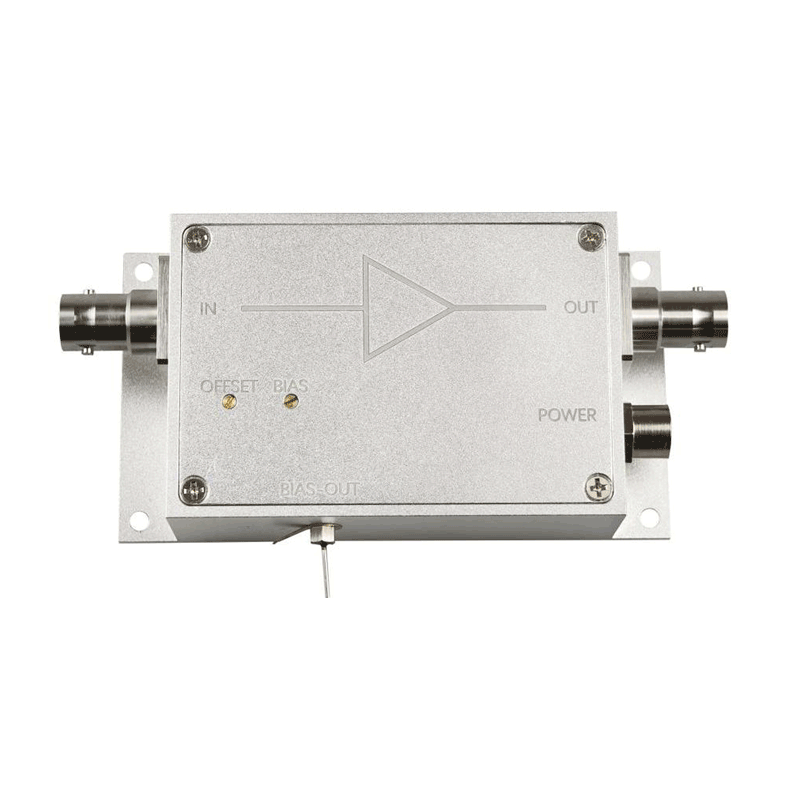
HCA High-Speed Current Amplifiers
HCA series transimpedance amplifiers optimized for bandwidth — from 1 MHz general photodetection to 400 MHz fast pulse and modulation capture. Model suffix indicates bandwidth and transimpedance gain (e.g. HCA-10M-100k = 10 MHz, 100 kΩ). Low pulse distortion for time-domain optical experiments.
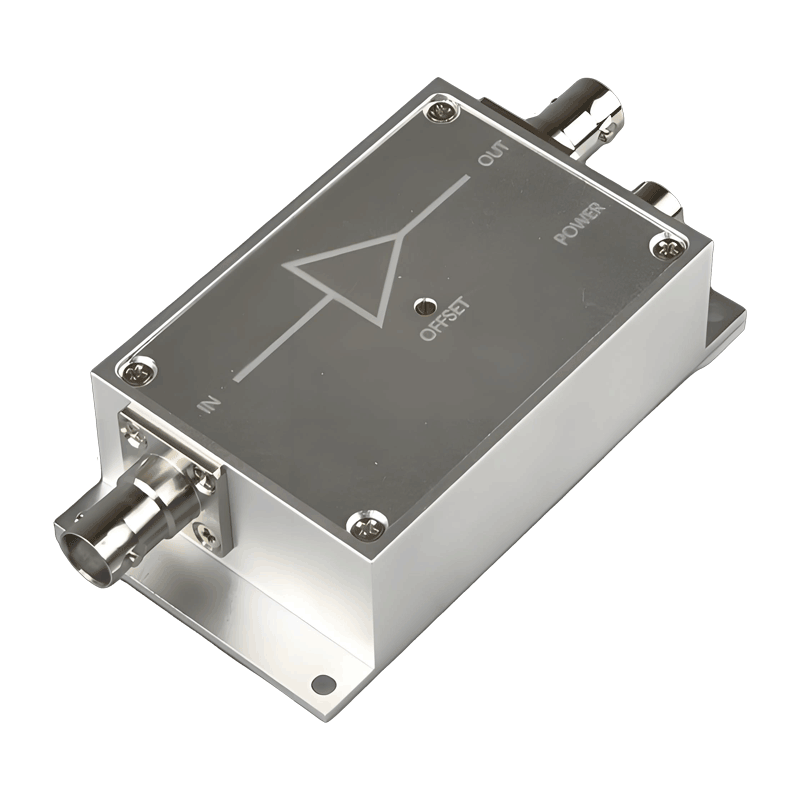
LCA Ultra-Low-Noise Current Amplifiers
LCA series transimpedance amplifiers prioritize noise floor and stability for precision photodetection — spectroscopy, lock-in measurements, weak fluorescence and DC/low-frequency optical sensing. Higher transimpedance gain (up to 500 MΩ) at lower bandwidth (10 kHz–400 kHz).
How to Choose a Transimpedance Amplifier
- Fast pulses or modulated optical signals (MHz+)? Choose HCA series — match bandwidth to your signal (e.g. HCA-10M-100k for ~10 MHz content, HCA-100M-50k for 100 MHz). Higher bandwidth models use lower transimpedance gain.
- Weak DC or low-frequency light — noise is critical? Choose LCA series — e.g. LCA-10k-500M for maximum gain at 10 kHz, or LCA-100k-50M for moderate bandwidth with 50 MΩ gain.
- Understanding model numbers: HCA/LCA-bandwidth-gain — first value is 3 dB bandwidth (M = MHz, k = kHz); second is transimpedance in kΩ or MΩ (500M = 500 MΩ, 100k = 100 kΩ).
- Need photodiode + TIA in one module? See integrated PIN photodetector modules or APD modules instead of standalone TIA.
- Multi-GHz fiber receiver already packaged? DMX60 high-speed photodetectors include GHz photodiodes; TIA modules suit custom PD + amplifier bench setups.
- Building from bare photodiode chips? Pair HCA/LCA with photodiode components and confirm photodiode capacitance vs TIA stability (consult datasheet for recommended PD types).
What Are Transimpedance Amplifier Modules?
A transimpedance amplifier (TIA) is a current-to-voltage converter — the fundamental front-end for photodiode detection. Photodiodes output photocurrent proportional to incident optical power; the TIA converts this to a measurable voltage while setting bandwidth and input noise. Standalone modules let engineers pair optimal photodiodes with the right gain–bandwidth trade-off for each experiment.
YB Photonics offers two complementary lines: HCA (high-speed current amplifiers) from 1 MHz to 400 MHz for fast optical events, and LCA (low-noise current amplifiers) from 10 kHz to 400 kHz with transimpedance up to 500 MΩ for precision measurement. Complete turnkey detectors are available in PIN, APD and high-speed photodetector categories.
Key Specifications to Compare
| Parameter | Why it matters | Typical range in this category |
|---|---|---|
| Bandwidth (3 dB) | Must exceed signal frequency; trades with gain | 10 kHz – 400 kHz (LCA); 1 – 400 MHz (HCA) |
| Transimpedance gain | Voltage per ampere of photocurrent | 5 kΩ – 1 MΩ (HCA); 10 MΩ – 500 MΩ (LCA) |
| Input noise | Minimum detectable optical power | Lower on LCA series; higher bandwidth = more noise (HCA) |
| Series | Speed vs sensitivity priority | HCA = high-speed; LCA = ultra-low-noise |
| Output | Connection to scope or DAQ | Voltage output, 50 Ω compatible (confirm per model) |
| Photodiode pairing | PD capacitance affects stability | External PD required — see photodiodes category |
Frequently Asked Questions
- HCA vs LCA — which transimpedance amplifier do I need?
- Choose HCA when your optical signal has MHz-class bandwidth (pulsed lasers, fast modulation, time-resolved experiments). Choose LCA when detecting very weak continuous or slowly varying light where noise floor dominates (spectroscopy, fluorescence, precision power monitoring).
- Why does higher bandwidth use lower transimpedance gain?
- Gain and bandwidth are coupled in TIAs — higher feedback resistance increases gain but reduces bandwidth and can destabilize with photodiode capacitance. YB Photonics model numbers encode the optimized gain–bandwidth pair for each variant.
- Can I use a TIA with any photodiode?
- In principle yes, but photodiode capacitance, dark current and wavelength responsivity must match your TIA choice. For plug-and-play detection, consider integrated PIN modules or APD modules with built-in TIAs.
- TIA module vs complete photodetector module?
- Standalone TIAs (this category) suit OEM prototyping and custom optical benches where you select the photodiode separately. Complete modules integrate PD + TIA + housing + connectors for faster system integration.